

How Yuma Is Building $TAO's Acceleration Engine
The biggest AI companies in the world aren’t accessible to most investors.
The biggest AI companies in the world aren’t accessible to most investors.
Public markets give you Google and Meta. And while they have real exposure, there’s no asymmetric upside. Private markets give you Anthropic and OpenAI, but only if you’re an LP in a top-tier Silicon Valley fund. The door is closed for everyone else.
This is the whitespace that Bittensor ($TAO) was built for. It’s the largest decentralized AI protocol by market cap. It’s open, permissionless, and free from the insider pre-mines that define its competitors.
However, a protocol alone doesn’t build an ecosystem.
Yuma, DCG’s dedicated operating arm inside Bittensor, is the institutional bet that the ecosystem is real. It’s a validator, subnet incubator, and institutional on-ramp rolled into one.
Our recent Supercycle with Yuma’s Chief Revenue Officer, Evan Malanga, unveiled what they’re building, and which bets are already paying off.
If you’re allocating to AI in 2026, read on to know where the asymmetric upside still lives.
Why Bittensor Doesn’t Need to Beat OpenAI to Win the AI Race
Malanga is direct about one thing: Bittensor can achieve entirely new AI categories without even stepping on OpenAI’s turf.
One of the strongest arguments is cost. Running AI training through centralized infrastructure, like AWS or Google Cloud, is extraordinarily expensive. On the other hand, Bittensor subnets are showing that distributed, incentivized compute can get you near the same results for a fraction of the price.
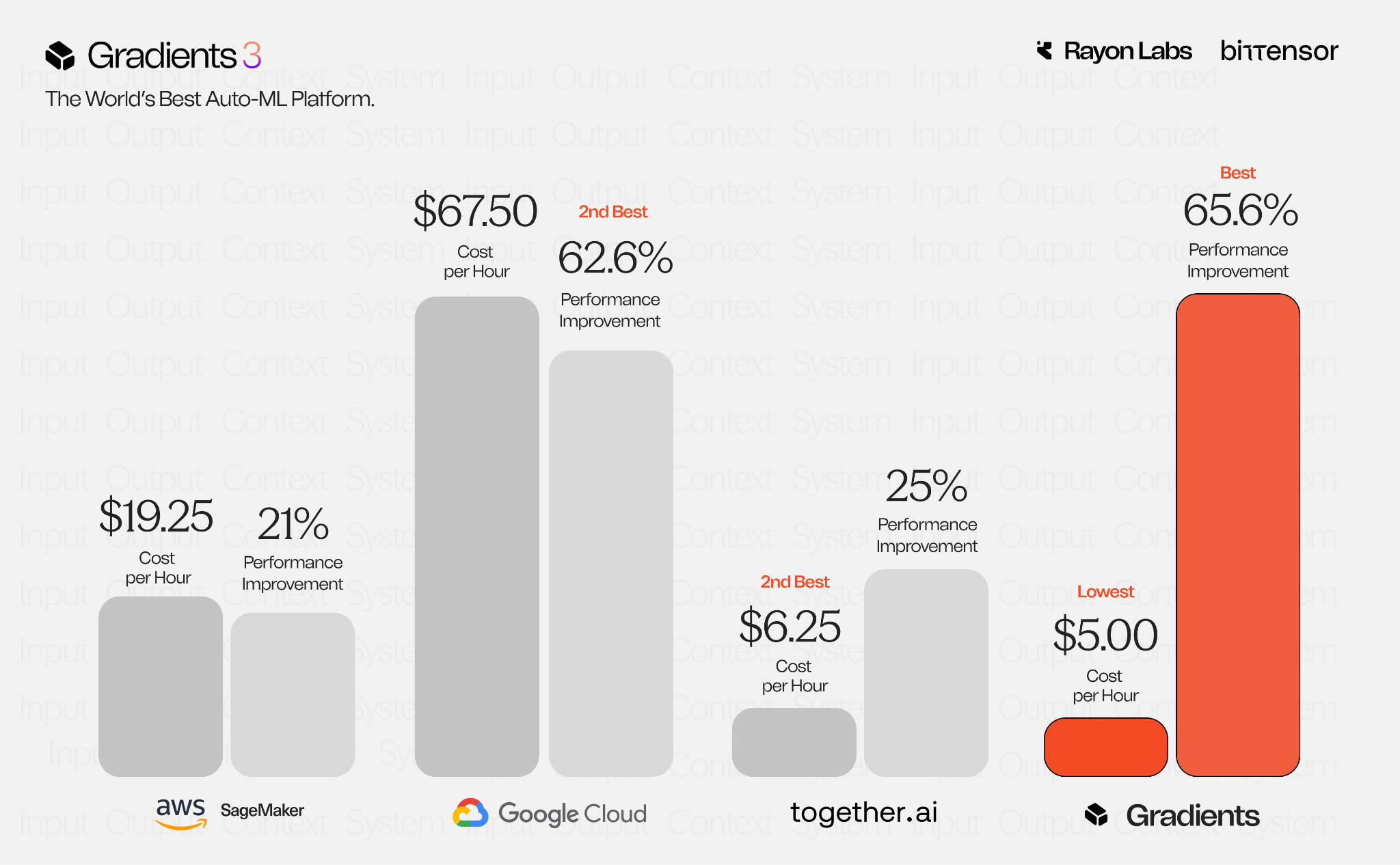
Subnets like Macrocosmos and Templar are doing distributed model training at a fraction of what a hyperscaler would pay. In fact, Macrocosmos recently launched training-at-home, allowing individuals to contribute compute to distributed training pipelines from their own devices.
We’ll be straightforward: the benchmarks of decentralized compute are yet to be state-of-the-art. But they are close — and cost way less.
Malanga further explains that, for investors coming from outside the ecosystem, he runs them through a decision tree.
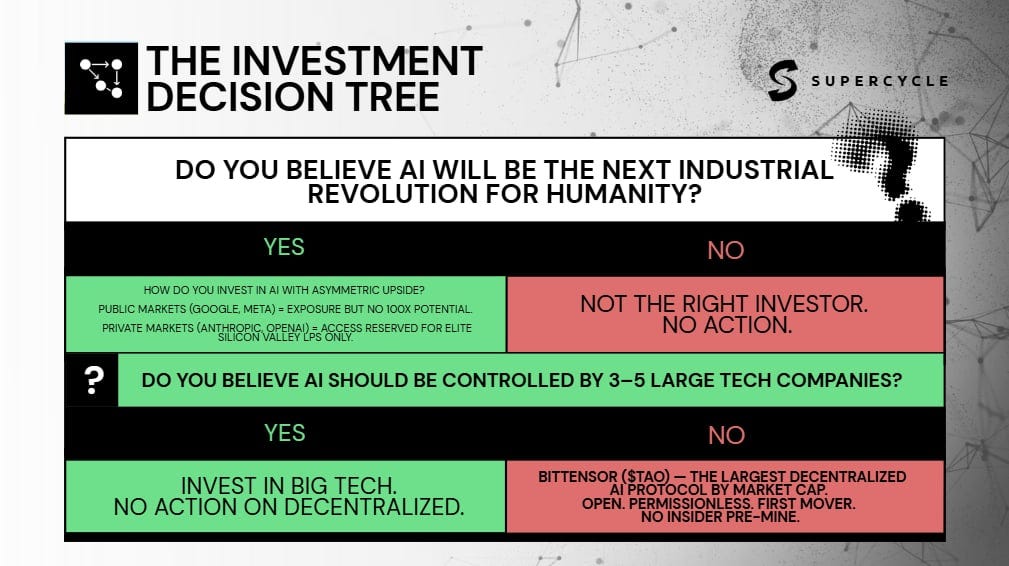
That framing, he says, is when the light bulb goes on for most capital allocators.
What’s striking is that Bittensor’s organic legitimacy was already being established long before institutions arrived to validate it. When DCG first evaluated Bittensor seriously in early 2024, the protocol’s annual emissions were approximately 4x the total venture capital flowing into all other Web3 AI projects combined.
Malanga laments that that was the conviction signal.
Because how is Bittensor’s organic growth outpacing the entire venture-backed field before most investors had even heard of it?
What is Yuma?
YumaGroup — or Yuma, for short — is a subsidiary of Digital Currency Group (DCG), and the firm behind Grayscale, Foundry, and some of the most durable infrastructure plays in crypto.
It is purpose-built to do for Bittensor what DCG has done for every major crypto category it has touched: build the infrastructure that makes institutional participation possible.
It operates across three verticals.
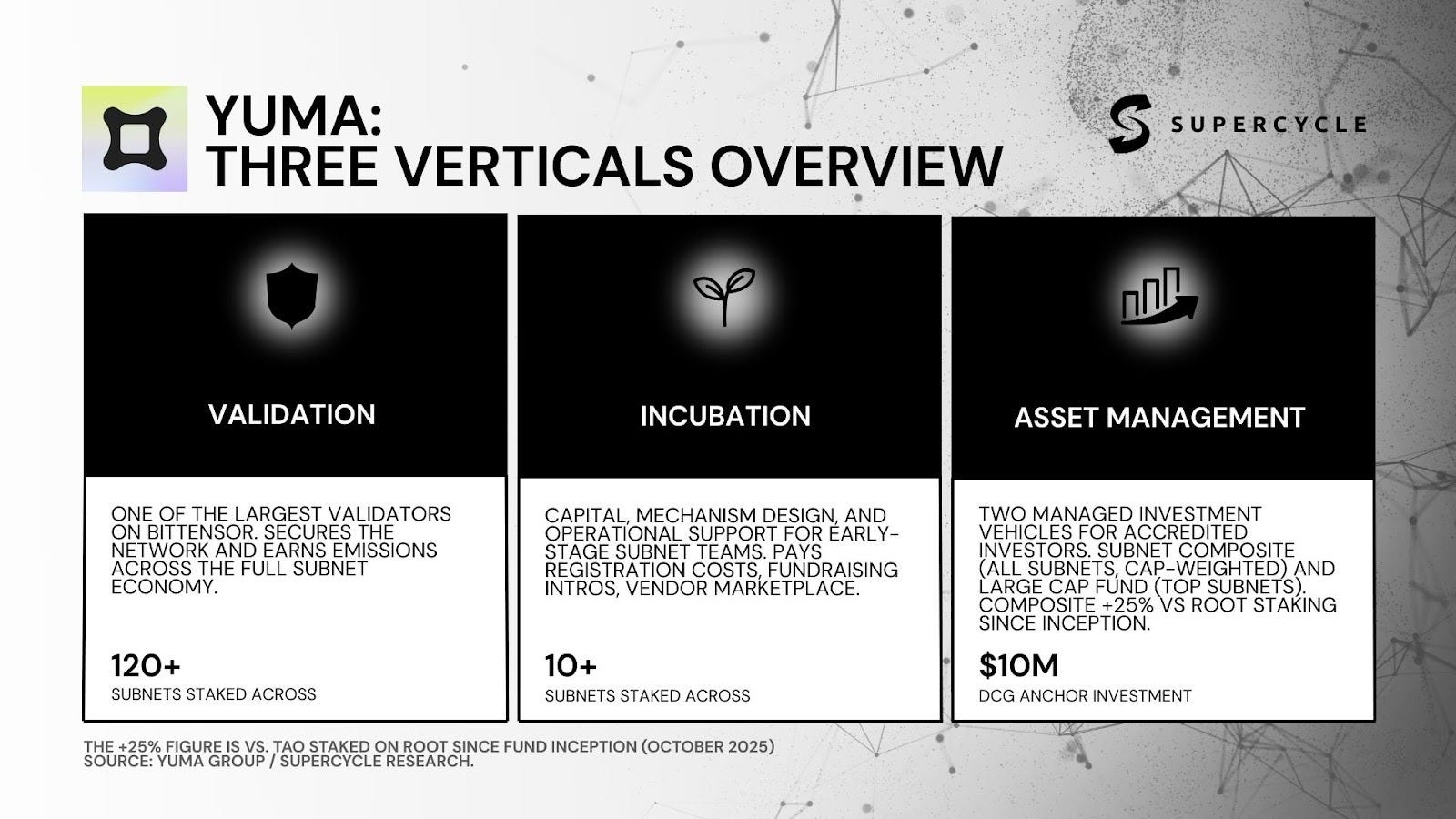
The three verticals aren’t separate bets, but rather, a flywheel. Incubation builds the supply of quality subnets, Validation secures the network and earns emissions, while Asset Management brings institutional capital in to meet them.
The Yuma Subnets Already Generating Revenue
Not every Bittensor subnet makes it to a customer conversation.
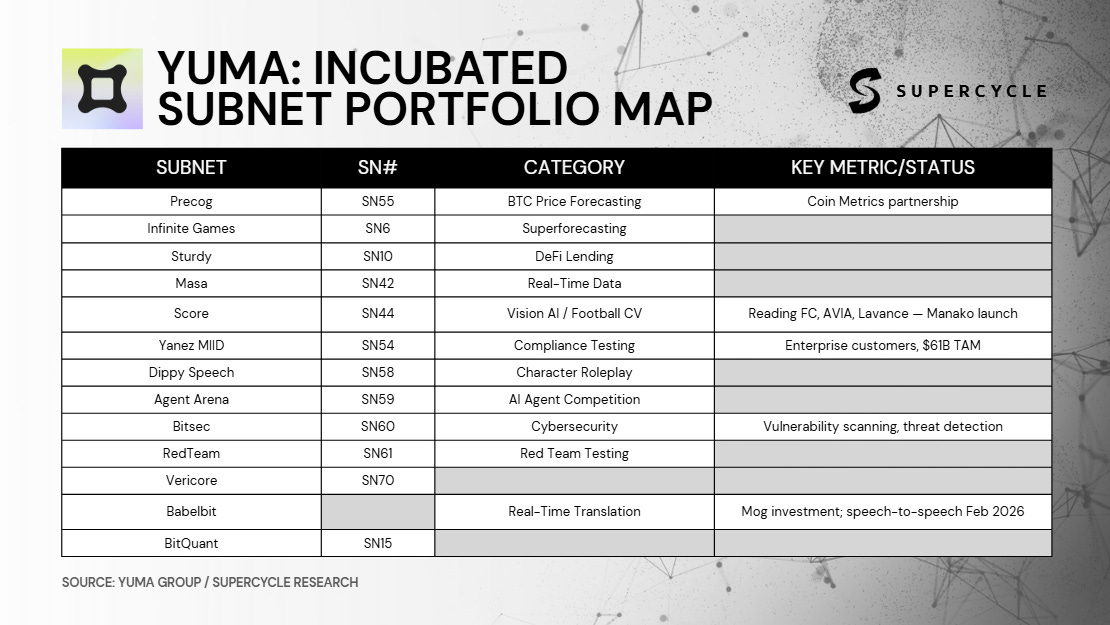
The ones below have, and, in some cases, are already closing enterprise contracts.
SCORE (Subnet 44)
SCORE is Yuma’s most prominent portfolio company and Malanga‘s personal favorite. The team was among Yuma’s first incubations before the firm even had a formal name.
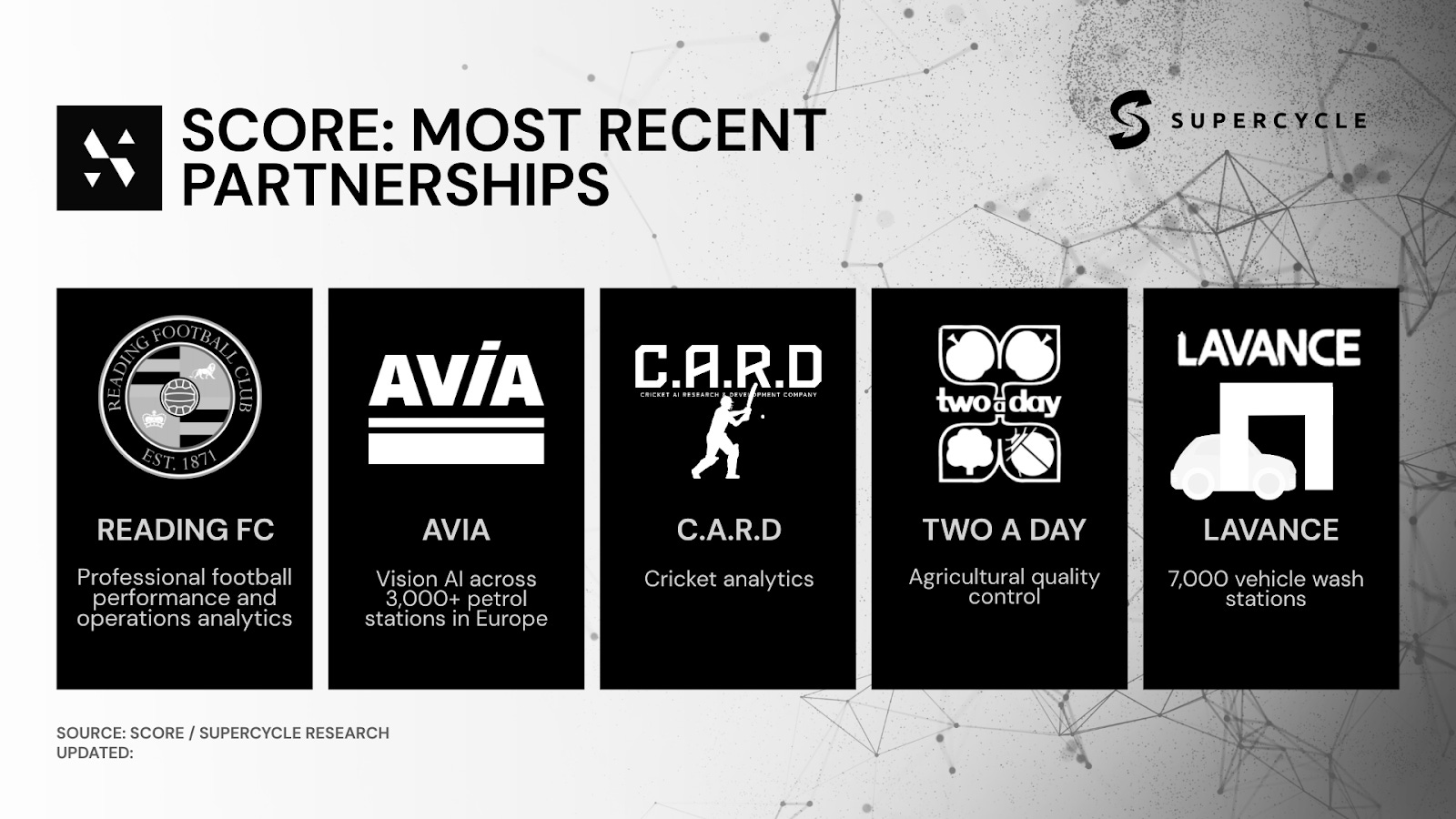
What started as computer vision for UK football clubs has expanded into manufacturing, fuel, and agriculture. The core product converts live video feeds into structured, queryable datasets.
The claim is it’s 10-100x cheaper (🚩: self-reported and unaudited, but directionally credible given the decentralized compute model). SCORE reports $3M annualized revenue from 7 enterprise clients, with an average contract value of $428K per client.
Three anchor enterprise clients were also signed in recent months, and SCORE reports a 100% trial conversion rate.
In February 2026, SCORE shipped MANIFEST, a mechanism upgrade that moves from static tasks to configurable production-grade specifications.
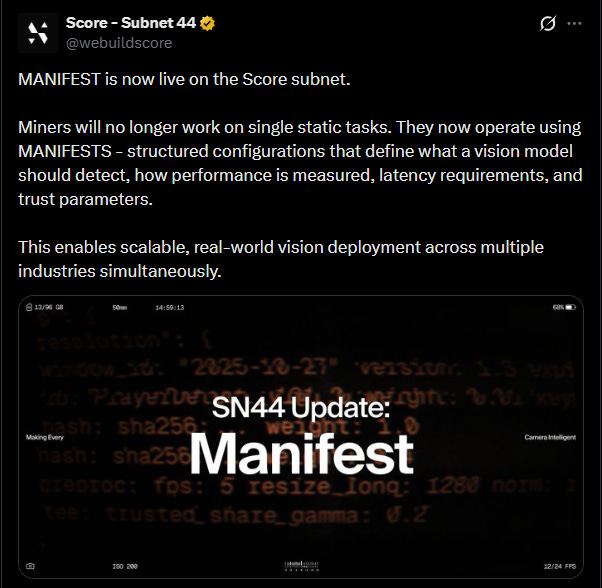
This is the shift from research subnet to production infrastructure. The team is also building a fantasy sports app for the 2026 World Cup, using their proprietary football data pipeline.
What to watch: Conversion of 60-day trials into multi-year contracts with guaranteed SLAs. $3M ARR from 7 clients is strong signal, but all revenue figures are self-reported and unaudited. The next proof point is independently verifiable contract data.
Yanez (Subnet 54)
Most Bittensor subnets are science experiments. Yanez is selling to compliance teams at banks.
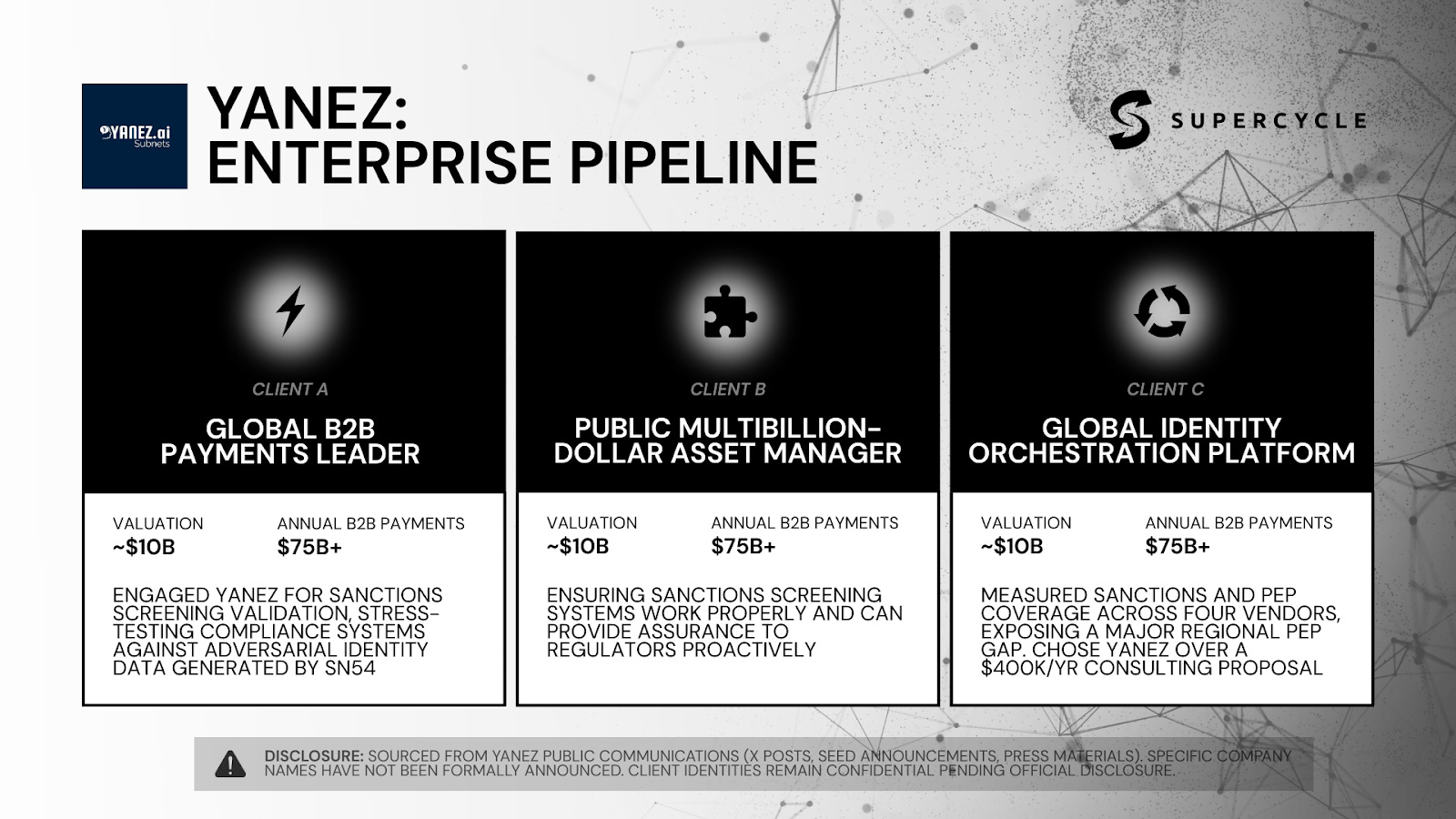
Launched during Proof of Talk in Paris, summer 2025, Yanez takes a novel approach to financial fraud and compliance testing. Rather than static defence, it incentivizes miners to constantly generate new attack vectors — like synthetic identities or deepfake-resistant biometrics — so clients can anticipate breaches before they happen
The TAM is $200B+ in AML/sanctions screening globally. Legacy vendors like LexisNexis and ComplyAdvantage serve it with slow-moving, static software. An open, incentivised competition for discovering new vulnerabilities is structurally better than anything a centralised vendor can build.
The team has earned early credibility. Founders who previously built and sold companies to Visa and McAfee, a $900K oversubscribed seed round, and screening provider integrations covering 75%+ of the market.
What to watch: Enterprise pilot conversions. The TAM is enormous and the team is credible, but signed contracts with named compliance buyers are the next proof point.
Babelit (SN59)
Babelbit is a real-time translation subnet built on Bittensor, expanding rapidly from text-to-text into speech-to-speech.
The founder came out of the SCORE team, moving from launch to a speech-based challenge mechanism in under six months..
Babelit uses LLMs to predict and complete phrases before the speaker finishes, eliminating latency in real-time video call translation. Multiple parameters like latency and speaker identity are all are testable on-chain.
Both the Taostats founder and a Bittensor Protocol co-founder have both publicly backed the project.
Bitsec (SN 60)
Bitsec is a cybersecurity subnet where AI agents compete against each other to find and fix code exploits.
Malanga shares that the founder’s pitch to Yuma was unconventional. Rather than a deck, he ran an active Foundry-operated subnet through his testnet, and delivered a complete vulnerability report.
When Foundry’s technical team reviewed the findings, they made the fixes. The product had proven itself before a single conversation about investment.
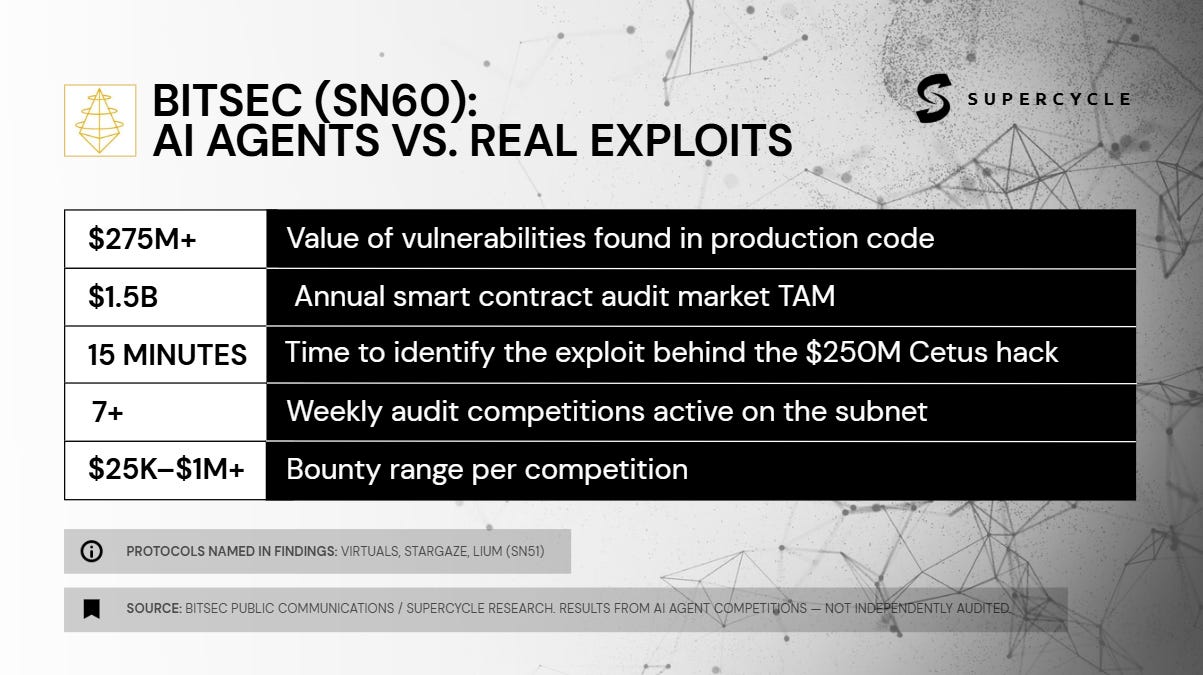
After a slow start as a solo founder, Bitsec underwent a significant V2 rebuild in late 2025, drawing inspiration from Ridge’s agent competition model.
In one case, Bitsec identified the same exploit that caused the $250M Cetus hack in under 15 minutes.
What to watch: Commercial adoption beyond competitions. Bug bounties prove capability. Enterprise contracts prove a business.
Yuma As The Institutional On-Ramp to $TAO
The asset management business was born from an access problem.
After the Dynamic TAO (dTAO) protocol update launched, the subnet economy exploded from 64 to 128 subnets in weeks. But the infrastructure to invest in it did not keep pace; major custodians like BitGo and Copper did not yet support subnet tokens. Meanwhile, exchanges like Kraken and Coinbase had TAO listed, but offered zero subnet-level exposure.
Yuma piloted its own products internally throughout spring and summer 2025, eventually launching two simplified investment vehicles for accredited investors in October 2025.
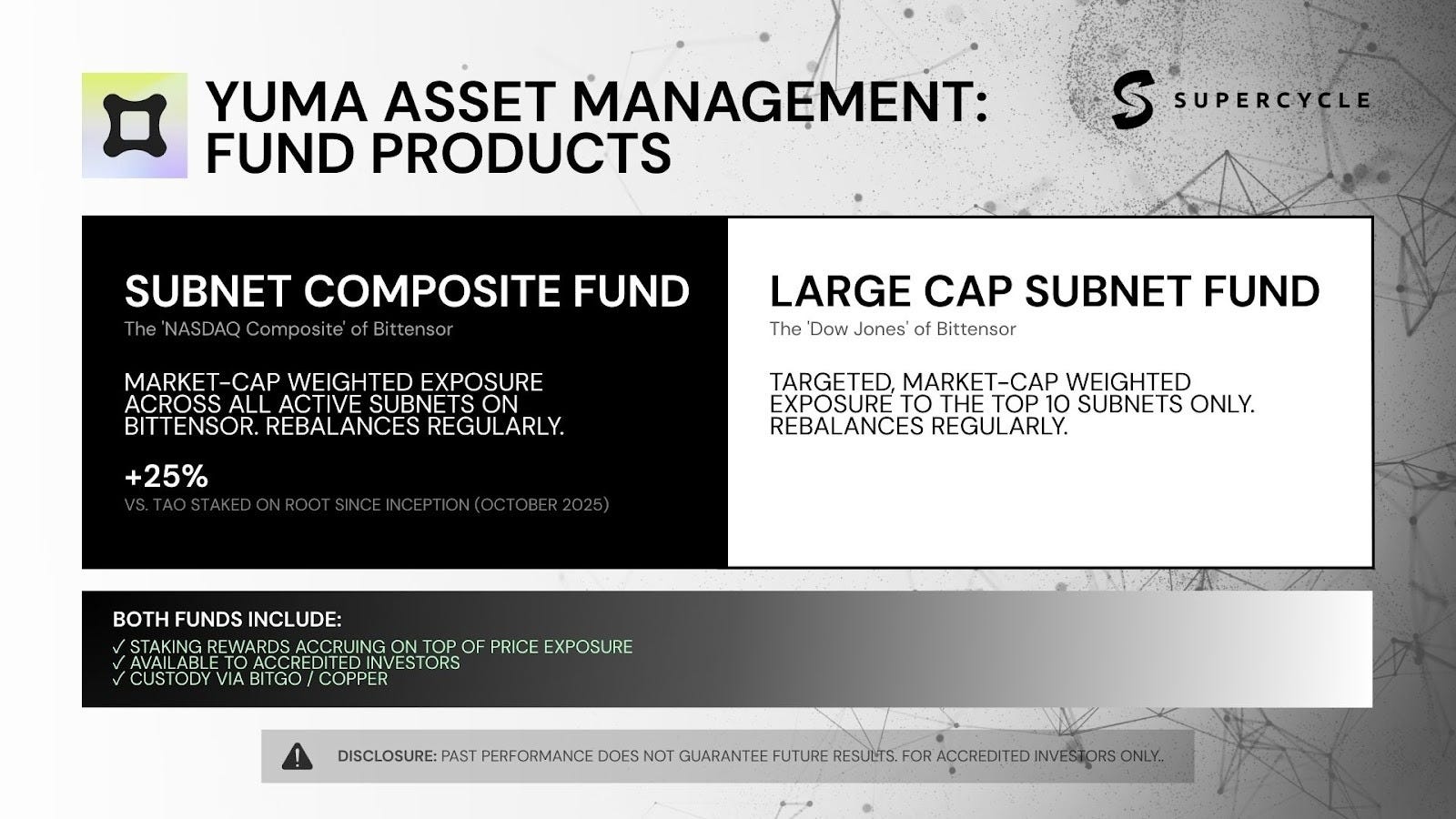
Since inception, the Subnet Composite has outperformed TAO staked on root by 25% in TAO terms, doing exactly what Yuma designed it to do.
The infrastructure is already institutional-grade. Yuma has partnered with over a dozen custodians and platforms to enable TAO staking through qualified custody.
If a TAO ETF ever emerges, the rails are already in place.
We’ve Only Scratched The Surface
Yuma’s conviction is simple: Bittensor doesn’t need to beat the labs if they just keep building what they can’t.
If that thesis plays out, we’re still in the early innings, and Evan has a lot more to say about where it goes from here.
The full conversation is on the Supercycle Podcast for free.